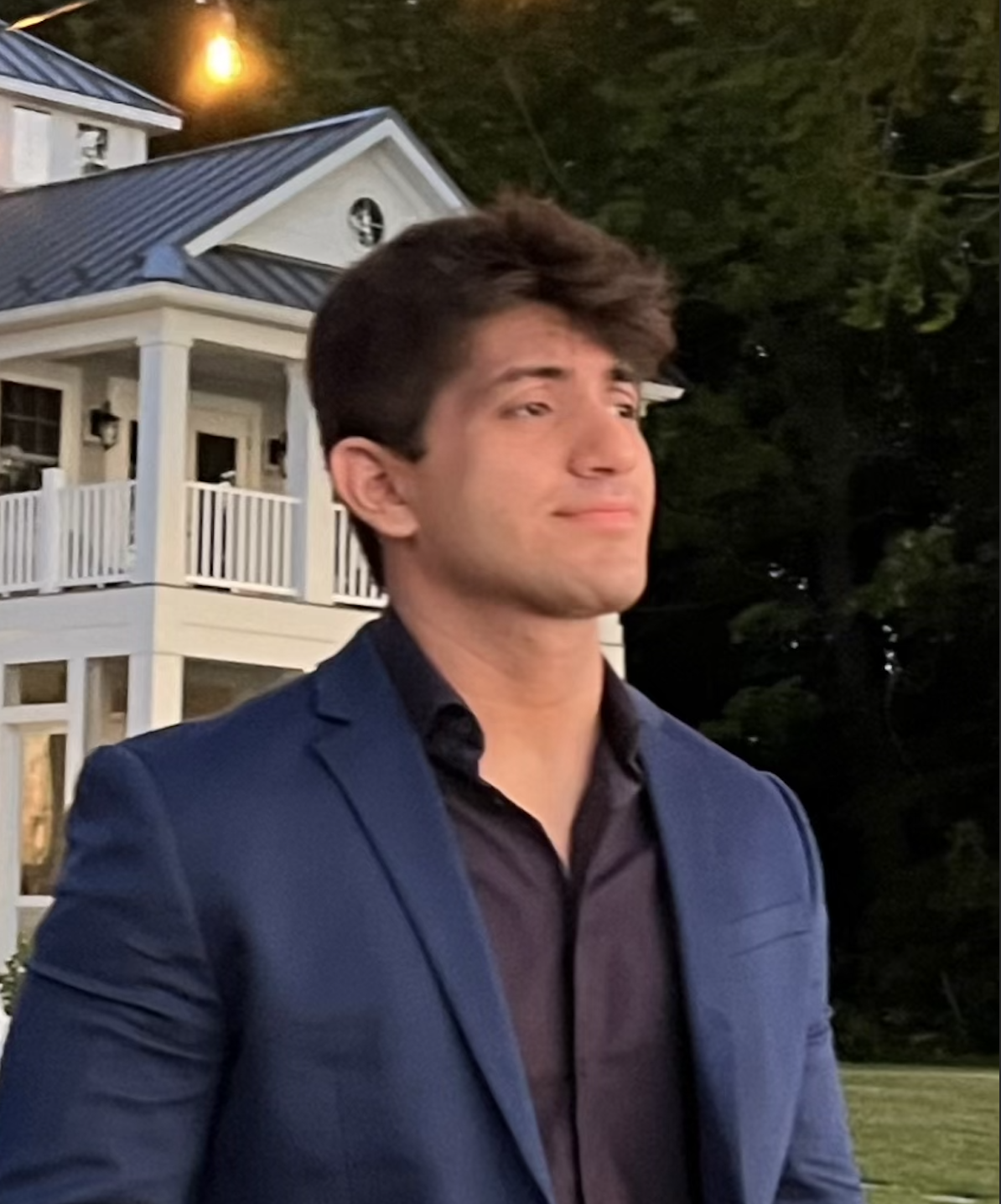
Curriculum Vitae
Education
- Ph.D. in Computer Science, University of Southern California, 2025-Present
- M.S. in Computer Science, Cornell University, 2022-2024
- B.A in Mathematics and Computer Science (Magna Cum Laude), Cornell University, 2018-2022
Coursework
Algorithms †‡ Deep Learning † Complexity Theory †‡ Combinatorics †‡
Learning Theory † Network Algorithms † Pseudorandomness † Analysis †‡
Control Theory † Lattice Algorithms † Cryptography Algebra ‡
†: graduate coursework, ‡: multiple courses
Publications
- Just how hard are rotations of ℤ^n? Algorithms and cryptography with the simplest lattice
Huck Bennett, Atul Ganju, Pura Peetathawatchai, and Noah Stephens-Davidowitz
EUROCRYPT 2023
[Arxiv]
Manuscripts/Working Manuscripts
A Theory of Time-Sensitive Language Generation: Sparse Hallucination Beats Mode Collapse
Atul Ganju, Travis McVoy, Shaddin Dughmi, Shang-Hua Teng
In Submission
[Arxiv]Active Learning via Regression Beyond Realizability
Atul Ganju, Shashaank Aiyer, Ved Sriraman, and Karthik Sridharan
In Submission
[Arxiv]
Research Experience
- Research Assistant @ University of Southern California (August 2025-Present):
- Equipped a well-studied framework for langauge generation to incorporate a notion of time-sensitivity. Showed that hallucination is necessary to achieve a breadth of output.
- Exploring the role of auxiliary data, both distributional and functional, in facilitating learning.
- Developing algorithms for domain adaptation that go beyond standard transfer learning guarantees.
- Research Assistant @ Cornell University (September 2023-May 2025):
- Designed and analyzed the first stream-based active learning algorithm with provable guarantees when the problem is not realizable. Mentored two undergraduate students in their first research experience in machine learning.
- Undergraduate Research Assistant @ Cornell University (January 2021-February 2022):
- Designed, implemented, and analyzed the results of experiments that tested the performance of basis reduction algorithms on bases for rotations of the integer lattice generated from a variety of basis sampling algorithms. Experiments were implemented in Python.
- Designed, implemented, and analyzed the results of experiments that determined how heuristic sieving algorithms perform on the integer lattice. Experiments were implemented in C++.
- Proved existence of orthogonal projection-based Cook reduction from ZSVP to 2-SVP.
Teaching Experience
- Graduate Teaching Assistant @ Cornell University
- CS 6784 Special Topics in Machine Learning: Control Theory (Fall 2022)
- CS 4820: Introduction to Analysis of Algorithms (Spring 2023)
- CS 4783: Mathematical Foundations for Machine Learning (Fall 2023)
- CS 4780: Introduction to Machine Learning (Spring 2024)
- Head Teaching Assistant @ Cornell University
- CS 4820: Introduction to Analysis of Algorithms (Summer 2021, Spring 2022)
- CS 4780: Introduction to Machine Learning (Fall 2021)
- Teaching Assistant @ Cornell University
- CS 4820: Introduction to Analysis of Algorithms (Spring 2021)
- CS 4780: Introduction to Machine Learning (Spring 2020, Fall 2020)
Technical Skills
- Languages: Python, Java, C, C++, Mathematica, OCaml, MATLAB, SQL
- Technologies/Libraries: Github, Pytorch, Tensorflow, Jupyter